.png)
VCE Science Excursions to Gumbuya World 2027
Bringing VCE Science to life through real-world investigation.
Our Gumbuya World excursions are designed specifically for VCE students, connecting classroom theory with authentic, large-scale systems in action.
These curriculum-aligned experiences allow students to gather data, analyse real environments and apply their knowledge in meaningful contexts.
Led by experienced VCE teachers and former VCAA assessors, each excursion is carefully mapped to relevant Units and Areas of Study across Chemistry, Physics, Biology and Psychology.

.jpg)
Our teachers are experienced VCE educators and former VCAA assessors who understand exactly what students need to succeed. These excursions are designed to deepen understanding, strengthen analytical skills and support SAC and exam preparation.
Simply choose your preferred term, register your school group, and join us for an engaging, data-rich learning experience outside the classroom.

VCE Science Excursions Schedule
Term 1 – Motion & Energy in Action
18th/19th February 2027
Units Covered
Chemistry Unit 3 AOS1 – Energy from carbohydrates, proteins & fats; redox; galvanic cells
Physics Unit 3 AOS1 – Motion
Term 2 – Systems, Regulation & Learning
22nd/23rd April 2027
Units Covered
Chemistry Unit 3 AOS2 – Rates, equilibrium, electrolysis
Psychology Unit 3 AOS2 – Learning & Memory
Biology Unit 1 AOS2 – Body systems & regulation
Biology Unit 3 AOS2 – Photosynthesis & cellular respiration
Term 3 - Genetics, Motion & pH
23rd/24th July 2027
Units Covered
Chemistry Unit 2 AOS1 – Environmental acidity
A report of a laboratory or fieldwork activity, including the generation of primary data.
Health of animal environmental enclosures is critically important when housing captive animals to maintain optimal living conditions. Thriving and happy animals rely on healthy environments for shelter and food.
Environmental testing for pH and adjusting the pH of soil and water is part of the testing required to maintain a healthy environment. In this excursion, students test the pH around the park including soil and water. This is critical for water animals such as the penguins and habitat maintenance. For their assessment, students need to do soil pH testing in a location in the park that is looking to be used for a new enclosure housing a non-native species. The plants required for this animal are also not native to Australia so a feasibility study is needed to be conducted around the pH of soil and water to investigate whether this environment is viable to house this animal and if not, how can we modify the conditions to suit them.
Physics Unit 2 AOS1 & AOS2 – Motion; Forces on structures and the human body
Biology Unit 2 AOS1 – Genetics
Biology Unit 4 AOS 1 — The Biological Defence Trail
Analysis and evaluation of a selected biological case study
In a captive environment like Gumbuya World, the management of animal health is a constant battle against pathogens. While wild populations rely on natural selection and environmental isolation, animals in close proximity to humans and other species face unique immunological challenges. To maintain a healthy collection, wildlife managers must understand the innate and adaptive immune systems of their animals, as well as the mechanisms of disease transmission between species (zoonosis).
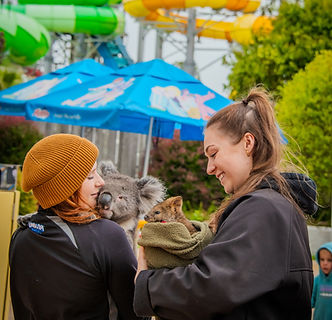
A primary aim of this excursion is to analyse immune responses (innate & adaptive), immunity acquisition, and disease treatment strategies of native Australian species. Students will investigate the various strategies used to manage pathogen transmission within Gumbuya World, learn how keepers manage the health of endangered species (like the Tiger Quoll) against pathogens (e.g., fungal infections or parasites) and the role of vaccination in wildlife conservation.
Students will be led through the Wildlife Trail with an experienced educator and they will gather quantitative and qualitative data on various species. The Koala’s battle with Chlamydia and the facial tumors of the Tasmanian Devil are presented as case studies and students complete a workbook during the excursion which forms the basis of their School Assessed Coursework for Unit 4 Outcome 1.
Biology Unit 4 AOS 2 — A ‘Tail’ of the Ancestors.
Analysis and evaluation of generated primary and/or collated secondary data.
This excursion focuses on evolutionary biology, including evidence for genetic changes in populations and how species have adapted and diverged over time. Students will use the Wildlife Trail at Gumbuya World to compare homologous and analogous structures across different Australian lineages (e.g., comparing the limbs of a Dingo vs. a Kangaroo) to discuss divergent and convergent evolution and can compare adaptations and relatedness among Australian Marsupials eg. Kangaroos and Tasmanian Devils. Collecting primary data, they will compare the phenotypes of related species at the park to infer genetic relatedness and common ancestry. They will also be provided with second-hand data and use this to construct a phylogenetic tree.
Students will discuss how natural selection or genetic drift (bottleneck effect) might have shaped these populations in the wild, and investigate a species that has changed due to environmental pressures or human intervention. They will investigate breeding programs for Dingoes to maintain genetic diversity and understand relatedness.
To end their exploration of evolution at Gumbuya World, there will be a discussion about human evolution and some of the history of the ancestors of Aboriginal and Torres Strait Islander peoples’ and their migration out of Africa and arrival between 50,000 and 65,000 years ago.
Students complete a workbook during the excursion which forms the basis of their School Assessed Coursework for Unit 4 Outcome 2.
Term 4 – Wildlife, Water & Chemical Analysis
14th/15th October 2027
Units Covered
Chemistry Unit 2 AOS2 – Water chemistry, solubility curves, stoichiometry, volumetric analysis
Biology Unit 2 AOS2 – Adaptation & reproduction
Fill up the form for enquiries